
Writing week 08
Owning and operating your own aircraft.

Monday
I’m well over halfway through my writing leave. I go back to work right at the start of October, and can detect a faint buzz of worry about time, like a mosquito zigzagging over to my side of a tent.
People keep reminding me that many writers fall apart when they have a lot of unstructured time. I wonder about this. I think it doesn’t have to be so black and white. You can fall apart, put yourself together, and fall apart again in just one day. You can get some things done and be falling apart at the same time; one doesn’t preclude the other. Maybe you could even say that falling apart IS getting things done, that it teaches you things about yourself and how you work that you would never otherwise learn. Or maybe I am speaking like somebody who doesn’t know how to work.
Today, for example: I wrote the drafts of two short prose pieces that I felt happy with, or that I thought might have legs as well as problems. But as the day went on, my faith in both pieces disappeared. I realised that this is always how it goes. The initial happiness about having something gives way to the conviction that the writing is lifeless and has nothing. I should’ve cleared out the gutters instead, should’ve suffered through some foul task that I’ll be uncomplicatedly glad to have done. But then later on I calmed down and looked at those pieces again, and I liked them, and kept working on them until I liked them more.
Today I also went to Writers on Mondays, a lunchtime event at Te Papa. One of the featured writers, the poet Haro Lee (whose new book I like very much), gave people Korean sheet masks at the end. More of this, at literary events.
Tuesday
Today I wrote two more prose pieces. Even while writing them, and enjoying writing them, I knew, secretly, that I was avoiding something: a particularly hard essay about planes. I have gathered material and written a few scenes, and from time to time I poke at these. The essay feels like a hopelessly tight knot and as I examine it I can’t see any thread to pull.
Out on a feeble walk/jog (I’m still not well enough to run at full tilt, and miss it sorely), I listened to a podcast episode (How I Write) with Anne Lamott. I remember liking and finding useful, many years ago, Lamott’s famous writing guide Bird by Bird, but haven’t read her work in a while, and I was in the mood for receiving advice.
Early on in the conversation, she says that one of her rules is to use strong verbs. Always expunge weak verbs from your sentences, she advises, and find stronger ones. ‘You could say, “I walked down the hall towards the kitchen,” Lamott says. ‘Not interesting. What if I stumbled down the hall?’
‘What if he staggered down the hall?’ suggests the host.
‘What if I army-crawled down the hall?’ cries Lamott.
Now, who among us is army-crawling to the kitchen? But then I thought about this advice more, and I’ve decided I like it. I like it because it is such a relief, sometimes, to come across truly terrible advice. Especially when a famous writer is giving it, reminding us that any of us can fall at any time. I get very overwhelmed by wisdom sometimes. Wise instruction has never been more available to us. Sometimes it makes me feel like panicking. How can I possibly make use of all this wisdom? Will I ever be so evolved? But when somebody has bad advice, I feel free; I remember that it is up to me to decide what is useful. (I also cast around: is there any way in which this advice might be good and I should be heeding it? Am I being defensive because I know, subconsciously, that my verbs are weak? Maybe there is some larger, good advice hiding behind the bad advice, like ‘One Train May Hide Another’ by Kenneth Koch, and the good advice is simply to pay closer attention to your sentences? And to stop walking around like a loser and start army-crawling.)
The rest of Anne Lamott’s advice was fair. Though I laughed when she said that as a young writer she had learned a lot from John Updike and ‘he had tiny issues with women, but putting that aside for a minute . . .’
I am listening to a lot of Philip Glass while writing. I have to say his work for The Truman Show is very good for writing to. But there is something inherently embarrassing to me about listening to film soundtracks. I always have to set my Spotify to private before I do it. I don’t want anyone to know that I’m listening to ‘Truman Sleeps’ or ‘Dreaming of Fiji’.
Wednesday
A friend and I have both submitted work to a journal. What if one of us elbows the other out? The ideal thing, to my mind, is that both of us are rejected. I don’t know how to explain this, but it’s better than if both of us are included.
Today I went for a walk, then opened up the troublesome essay. Sometimes even just opening a document really is terrible. There should be a special category called ‘Opening the document’ at the book awards. But as I started writing some sentences and moving a few things around and seeing where the gaps were, I felt like maybe I could see something. I sat in a cafe and did a bit more.
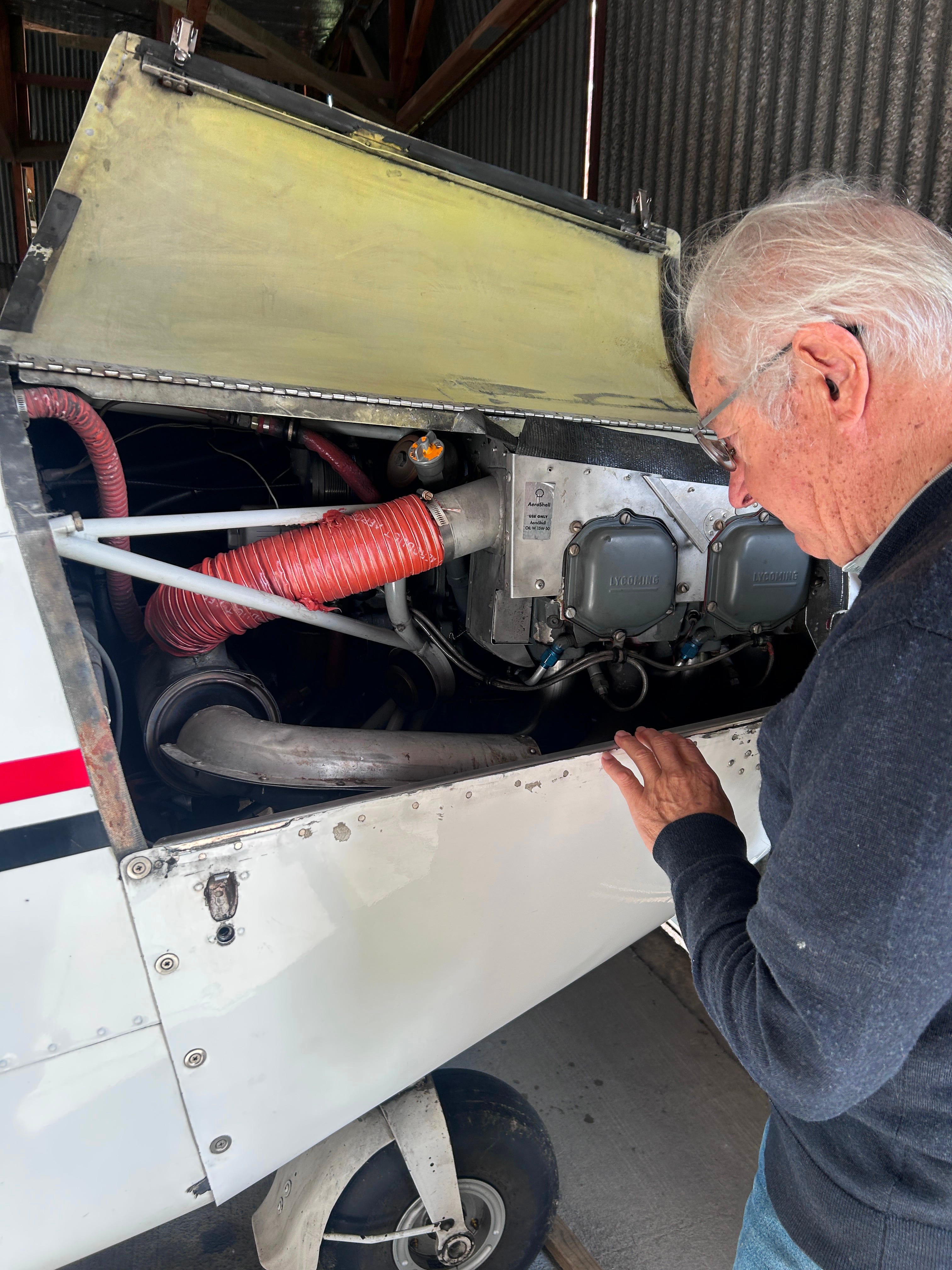
In order to eventually complete this essay, I think I need one more crucial piece of material. The thing I need to do is to go up in the plane with my dad, who has lost the use of his arm and currently can’t fly, so we will need another pilot to fly us. So I started to figure out if that would be possible.
I also looked back over the transcript of an interview I did a while ago and, as always, was humbled by the inanities I spout. As well as adding nothing, they make the transcript harder to parse. But I know that the next time I try to interview someone, I’ll be up to my old tricks. ‘Yeah,’ I’ll say. ‘Yeah yeah yeah. Yeah.’
Thursday
It was hard to get myself started this morning. I faffed around, and wrote a couple of emails to friends. Emails! I used to write so many emails to friends – big rambling emails full of analysis and bitching and confusion – and they would send rambling emails back, which I fell upon greedily. I was lucky to have very wise and funny emailing friends, and I would learn a lot from everything they wrote. I think about how easy it was to write those emails, and how much I looked forward to writing them. But somewhere along the line, work emails became the only emails in town.
Once I sat down, I was able to keep working on the essay. I also made an OIA request for some information about a small aircraft that crashed in 1997. I have never made an OIA request before. Making the request felt a little like putting on googly-eye glasses and a moustache to fool people that I am a real researcher.
I also got a book out of the library called Owning and Operating Your Own Aircraft. I thought it would help me to understand a bit more of the mindset of people who fly small planes. What has happened, though, is that this book is hilarious and I can’t learn anything from it because I am laughing too much. The book is not meant to be funny. But the writer is determined that we must all own our own aircraft. Yes, there are some alternatives – we could own one in a syndicate arrangement, but the downsides of this are many; what if someone in your syndicate is a miserable bastard? – and really the only thing for it is to buy your own plane. ‘We hope you enjoy owning your own plane!’ he shouts at the end of the introduction. I also enjoy the way he writes about pilots, as if they are otherworldly creatures guided by special urges. ‘During the spring,’ he writes, ‘a pilot’s thoughts turn to buying planes.’
The book has got me thinking about exclamation marks, which the writer uses liberally in his exhortations to buy a plane. In the last couple of weeks, I had a hankering to use one or two. Then I used more. I am really enjoying bringing exclamation marks back in from the cold.
Of course, the right thing to do is to go back through later on and take all of them out.
I wonder if I will ever finish anything.
Friday
Something happened today where I was able to go fully into that essay. It turned out I’d just needed to spend some patient time with it so that I could start to see the threads I can tug. It feels like the knot of it is loosening a bit. There is still an impossible amount of work to do, but just being able to look at it without curling into the foetal position is very helpful.
I’ve also realised that it’s good if I can identify – the earlier the better – the places where a piece might be funny. Even if these are just small, very stupid moments of no consequence. Maybe it’s shallow, maybe it’s a fear of thinking about things seriously – but the funny bits are like buoys that give me perspective and help me see where I am.
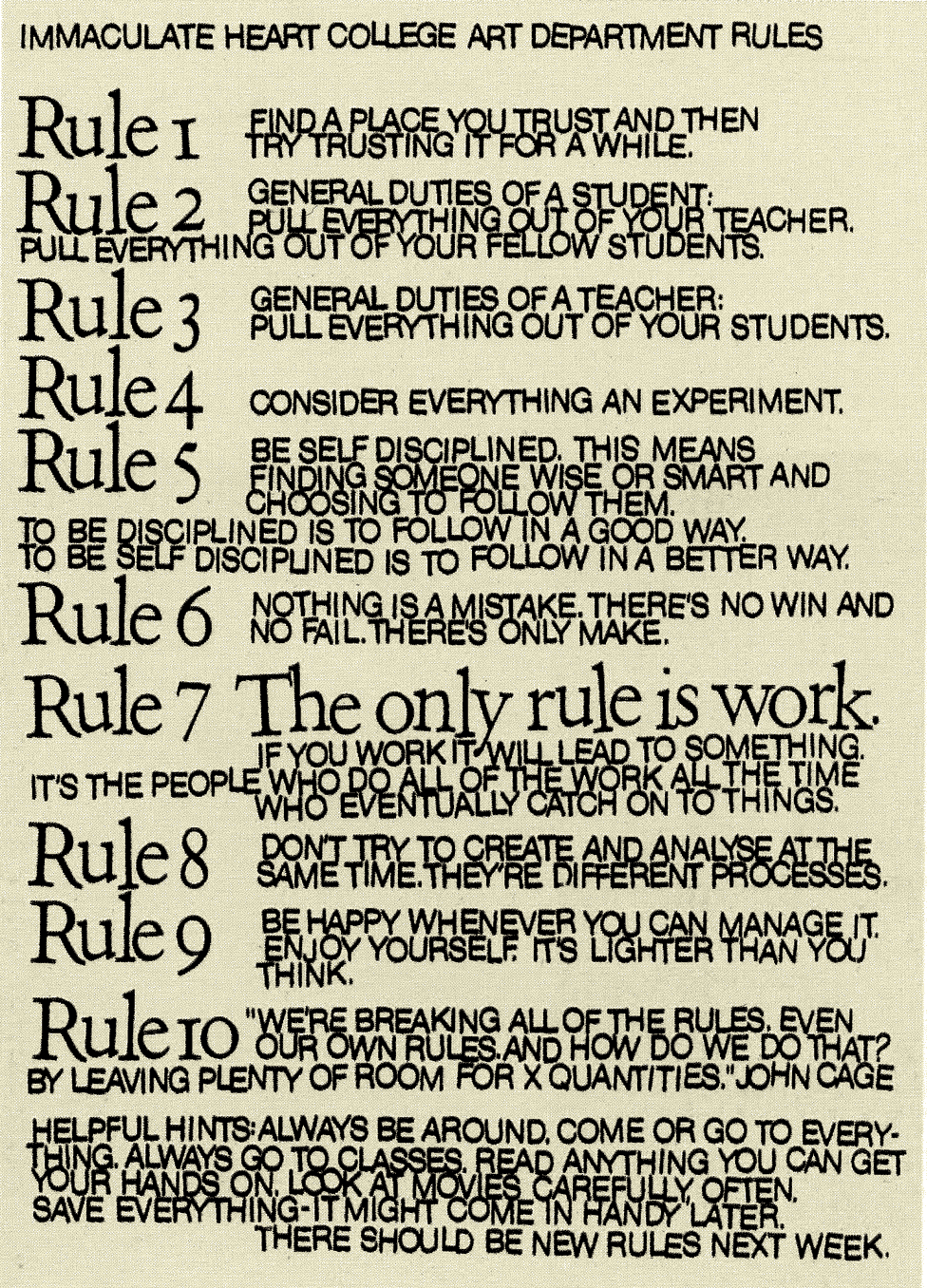
Happy writing everybody, as ever, and thank you for reading this far. Here’s a lovely thing I keep coming back to – shared by novelist Charlotte Wood – it is artist and teacher Sister Corita Kent’s Some Rules for Students and Teachers, from around 1967, written for the art department at the Immaculate Heart College.
I recently read Julian Barnes' book, Departure(s) where he talks about the use of exclamation marks, and how he abhors them. I used to use them a lot, but now try to think of more energetic ways of writing to describe the feeling of an exclamation.
As an aside, the Karori Community Facebook page used to be I Love Karori!!!. In our family we would speak out the punctuation. It sounded better to say 'exclamation mark' three times after the title. The exclamation marks disappeared overnight, about 18 months ago. I was devastated!!!
really enjoyed this update (& speaking of moments of funny, it made me laugh out loud a couple of times - we should all be army-crawling more!) :)